



Understanding Executive Dysfunction in Children with ADHD
Enhancing Executive Functions in Children with ADHD or ADD is essential because these children often struggle with executive dysfunction, which hampers their ability to plan, organize, and regulate their behavior. Executive functions are the mental processes that enable us to manage our time, focus attention, switch gears, and achieve goals. In children with ADHD, these processes may be underdeveloped or less efficient, leading to difficulties in daily activities and academic performance.
According to recent studies, enhancing executive functions in children with ADHD is crucial, as up to 90% of these children exhibit significant executive function deficits, impacting their academic success, social relationships, and emotional well-being (Barkley, 2023). The seven core executive functions that are commonly affected in children with ADHD include:
- Self-awareness: The ability to monitor and evaluate one’s own behavior.
- Inhibition: The capacity to control impulses and resist distractions.
- Non-verbal working memory: The ability to hold and manipulate visual-spatial information in the mind.
- Verbal working memory: The ability to retain and use information from past experiences to guide current actions.
- Emotional self-regulation: The ability to manage and respond to emotional experiences appropriately.
- Self-motivation: The ability to initiate tasks and persist toward achieving goals.
- Planning and problem-solving: The capacity to create a roadmap for achieving a goal and overcoming obstacles.
As a parent, understanding these challenges and focusing on enhancing executive functions in children with ADHD is crucial. This guide provides ten practical strategies to help your child develop these essential skills and gain more control over their ADHD symptoms.
1. Establish Accountability

One of the most important steps in helping your child develop stronger executive functions is enforcing accountability. ADHD is not an excuse to avoid responsibilities. While it is true that ADHD can make tasks more challenging, it is essential to teach your child that they are still accountable for their actions.
Accountability begins with clear expectations. Establish rules and consequences, and ensure that your child understands them. For instance, if they forget to complete their homework, rather than doing it for them, help them understand the importance of their responsibility and encourage them to follow through. This approach fosters independence and reinforces their ability to manage tasks on their own .
2. Utilize Visual Supports

Children with ADHD often struggle with working memory, which can make it difficult for them to retain information and follow through on tasks. To combat this, make information visible and accessible. Use visual supports such as charts, lists, sticky notes, and planners to help your child remember what needs to be done.
For example, create a morning routine checklist that your child can refer to each day. This not only helps them stay on track but also encourages the development of organizational skills. Visual reminders serve as external cues, enabling your child to compensate for memory deficits and improving their ability to plan and execute tasks effectively.

3. Make Time Tangible
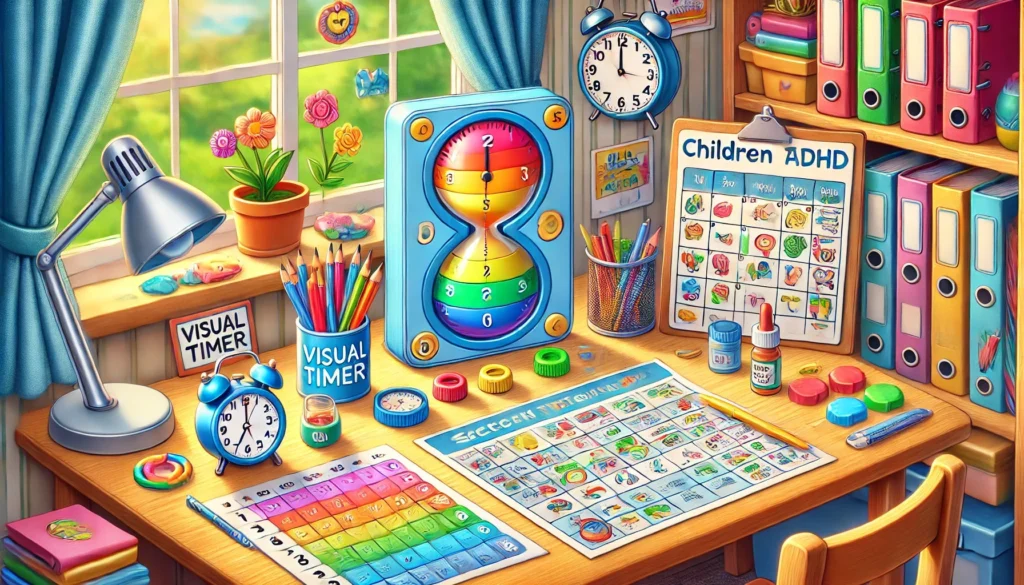
Children with ADHD often experience “time blindness,” a difficulty in perceiving and managing time effectively. This can lead to procrastination and poor time management. To help your child overcome this challenge, make time tangible by using timers, clocks, and visual schedules.
Introduce your child to a visual timer that counts down the time left for a specific task. This can help them better understand how much time they have and motivate them to work within that timeframe. Additionally, break down tasks into smaller, manageable steps with allocated time slots, making it easier for your child to complete assignments on time .
4. Implement a Reward System

Motivation can be a significant challenge for children with ADHD, particularly when tasks lack immediate rewards. A reward system can help bridge this gap by providing external motivation. Create a token economy or daily report card system where your child earns points or tokens for completing tasks, which they can later exchange for rewards.
Rewards should be meaningful and tailored to your child’s interests. For example, earning screen time, a special outing, or a small toy can serve as powerful incentives. Over time, these external rewards can help your child develop internal motivation, reinforcing their self-motivation and goal-directed behavior.
5. Encourage Hands-On Learning

Children with ADHD often benefit from kinesthetic learning—learning that involves physical activity and hands-on experiences. Engaging your child in activities that require physical manipulation can enhance their verbal and non-verbal working memory.
For instance, use physical objects like blocks or beads to teach math concepts, or encourage your child to write out spelling words with magnetic letters. These activities help bridge the gap between verbal instructions and non-verbal processing, making abstract concepts more concrete and easier to understand.
6. Incorporate Regular Breaks

Self-regulation is a finite resource that can quickly become depleted, especially in children with ADHD. Long periods of focus can lead to mental fatigue, making it harder for your child to stay on task. To prevent burnout, incorporate regular breaks into their routine.
Encourage your child to take short breaks every 20-30 minutes during homework or other demanding tasks. These breaks should be structured and short (3-10 minutes) to allow them to recharge without losing focus. Activities like stretching, a quick snack, or a brief walk can help reset their executive function capacity, enabling them to return to the task with renewed energy.

Take ThisFree Quiz:
ADHD Symptom Quiz for Children: Is Your Child Displaying Signs?
7. Promote Positive Self-Talk

Positive self-talk is a powerful tool for children with ADHD. It helps them build confidence, overcome challenges, and stay motivated. Teach your child to use affirmations and encouraging phrases like “I can do this” or “I am capable” when faced with difficult tasks.
Role-playing scenarios where your child practices positive self-talk can be beneficial. Encourage them to visualize success and mentally rehearse the steps needed to achieve their goals. This practice not only boosts their confidence but also enhances their planning and problem-solving skills.
8. Emphasize Physical Activity

Physical exercise is not only beneficial for overall health but also for enhancing executive functions. Regular physical activity has been shown to improve cognitive processes such as attention, memory, and self-regulation, making it an essential component of any ADHD management plan.
Encourage your child to engage in physical activities that they enjoy, whether it’s a team sport, swimming, or even a daily walk. Incorporating physical exercise into your child’s routine can help them manage their ADHD symptoms more effectively and improve their executive function skills.
9. Monitor Sugar Intake

While sugar has a reputation for exacerbating ADHD symptoms, it can also play a role in enhancing executive function during demanding tasks. The frontal lobe, where executive functions are controlled, relies on glucose for energy. Providing your child with a small amount of sugar, such as a sip of lemonade or a sports drink, during intense cognitive tasks can help fuel their brain and improve performance.
However, moderation is key. Ensure that your child consumes sugary drinks sparingly and only during activities that require significant mental effort, such as exams or long homework sessions.
10. Foster Compassion and Understanding

Lastly, compassion is a cornerstone of effective parenting for children with ADHD. It’s important to remember that your child’s executive function challenges are not a reflection of their intelligence or effort. Instead of reacting with frustration when they struggle, approach the situation with empathy and support.
Help your child learn from their mistakes by discussing what went wrong and how they can improve next time. This approach not only builds resilience but also strengthens the parent-child relationship, providing a secure foundation for your child to thrive.
Conclusion
Supporting a child with ADHD by enhancing executive functions in children with ADHD requires patience, consistency, and a well-rounded approach. By implementing these strategies, you can help your child build the skills they need to navigate daily challenges, improve their academic performance, and gain greater independence. Remember, every child is unique, so it’s important to tailor these strategies to fit your child’s individual needs.

Read This Next:
Boost Your Working Memory: Brain Training Tricks